
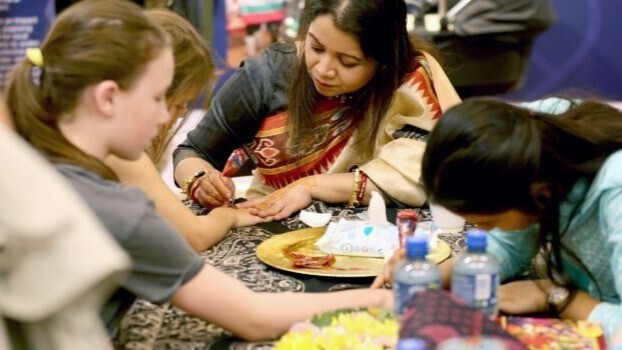
Participants at the Irish Linen Centre and Lisburn Museum's Welcome Day, a vibrant public event hosted by the migrant community in Birmingham, UK
Recent rhetoric and policy proposals, such as former President Trump’s alarming plan to deport 17 million people through the use of detention camps and forced returns, underline a disturbing global trend: the growing villainization of migrant communities. While such strategies promise to devastate economies and tear apart communities, they also reinforce a broader cultural narrative—one that paints migrants not as contributors to societies, but as threats.
The recent experience of the Hattian community in Springfield, Ohio is just one example. Invited to Springfield as cheap labour, they were the subjects of a baseless hoax spread online saying Haitian immigrants were stealing and eating pets in that community. The claims began with a local Facebook group post claiming a local cat had been butchered, and spread quickly among far-right and neo-Nazi groups. The narrative was amplified by the Trump campaign and soon bomb and death threats from oversees followed. Local authorities have investigated and have refuted these claims, yet the story was amplified at an international level.
The Rise of Villainization
Globally, the rise in anti-migrant sentiment is stark. A 2023 report from the Migration Policy Institute noted that over 60% of surveyed individuals in Western nations believed migrants “pose a threat” to cultural values and economic stability. In Canada, a country traditionally celebrated for its multicultural ethos, hate crimes targeting immigrants rose by 27% between 2019 and 2022, with smaller communities seeing the steepest increases. The UK has similarly grappled with rising xenophobia, exacerbated by heated Brexit debates and misinformation campaigns. Meanwhile, in the United States, a staggering 74% of Republicans reported in a 2024 Pew Research poll that they felt immigration had a “negative” impact on society.
These statistics underscore a worrying trend: the narrative surrounding migration is increasingly framed by fear and division, often leaving little room for the voices of migrants themselves to challenge these perceptions.
The Economic Cost of Exclusion
While the moral imperative to support migrant communities is clear, the economic argument is just as compelling. Deporting millions, as some propose, would come at an astronomical cost. In the U.S., estimates for mass deportation range from $100 to $300 billion—figures that do not account for the economic contributions lost through the removal of workers, entrepreneurs, and consumers.
In Canada, immigrants make up nearly 25% of the workforce, and their contributions are critical to addressing labor shortages in sectors ranging from healthcare to technology. In smaller communities, where population decline threatens local economies, migrant settlement programs have proven essential in revitalization efforts. By contrast, exclusionary practices and policies risk driving long-term economic stagnation and social instability.
What Can Be Done?
The UK's Centre for Cultural Value recently highlighted a project they had funded with the Irish Linen Centre and Lisburn Museum through their Collaboration Fund. The Yours, Mine and Ours project aimed to develop sustainable collaborative relationships with local migrant communities, many of whom had yet to experience what the museum has to offer.
The project demonstrated that local museums are more than places to preserve the past – they are powerful shared spaces shaping the future. Yours, Mine and Ours reminds us that when institutions share authority and truly listen to their communities, they can create meaningful connections and amplify voices that might otherwise go unheard. = The Centre for Cultural Value
The Yours, Mine and Ours project's is a great example of a project where authority was shared. Participants from local migrant communities co-designed the project, shaping everything from the content of facilitated workshops and craft sessions to the museum’s Welcome Day. In this vibrant, participant-led public event, new voices took centre stage to celebrate cultural exchange. on capturing migrant voices is a powerful reminder of what is at stake—and how we can respond.
The Power of Amplifying Migrant Voices
In an article, Yours, Mine,and Ours: Capturing the Voices of Migrant Communities, Cultural Value communicates an essential truth: to stem the tide of hate, we must amplify the voices of migrants themselves, by creating opportunities for them to share their stories and experiences within a broader cultural fabric. By engaging migrant communities in cultural storytelling and initiatives, it becomes possible to humanize migration, counteract stereotypes, and foster connections that transcend fear.
One poignant example from the Yours, Mine, and Ours article details an event where migrants in Birmingham, UK, were invited to share personal objects that symbolized their journeys. These stories sparked conversations among diverse groups, helping residents see commonalities and shared values. “I always thought their [migrants’] struggles were so different from mine, but their hopes and dreams are just like ours.”
Similarly, in Canada, the Toronto-based project “My Neighbour” has been capturing the oral histories of immigrants to counter anti-immigrant sentiment. By archiving these stories in local libraries and showcasing them in schools, the initiative fosters empathy in communities where negative stereotypes might otherwise take root.
The Role of Dialogue
Dialogue is a vital tool in stemming the tide of anti-migrant sentiment. Here are actionable ways to foster understanding and collaboration:
Amplify Migrant Voices: Initiatives like storytelling workshops, community exhibitions, and oral history projects are essential in creating platforms where migrants can share their experiences firsthand. The authenticity of these stories can dismantle fear and foster empathy.
Encourage Cross-Cultural Exchange: Events that bring together diverse groups—from shared meals to collaborative art projects—help break down barriers. The more communities interact, the more they can see beyond stereotypes.
Educate for Empathy: Schools, libraries, and museums play a critical role in fostering inclusive attitudes. Integrating migrant narratives into education and cultural programming can challenge biases before they take root.
Policy as Culture: Policymakers should champion frameworks that celebrate diversity and integration. From funding local initiatives to addressing systemic inequities, policies can set the tone for a more inclusive society.
A Shared Responsibility
As global citizens, the responsibility to counter the villainization of migrants does not rest on governments alone. Cultural institutions, community organizations, and individuals each play a role in shaping the narrative. By fostering dialogue, amplifying marginalized voices, and celebrating the rich contributions migrants bring to our societies, we can turn the tide.
The challenge is immense, but the stakes are higher. As the Yours, Mine, and Ours article reminds us, creating inclusive spaces for migrant stories is not just about acknowledging their pasts; it’s about shaping a shared future. One built on understanding, respect, and the recognition that “yours”, “mine”, and “ours” are interconnected. In the face of divisive rhetoric, let us choose dialogue over division. It’s a choice that reflects not only our shared humanity but also our commitment to a more equitable and inclusive world.
Case Study: Yours, Mine, and Ours – Irish Linen Centre and Lisburn Museum
For many years, the Irish Linen Centre and Lisburn Museum has made engaged community practice a core part of its service, weaving it into the fabric of the organization’s exhibitions, events, and activities. This approach has not only deepened the museum's connection to its community but also helped uncover areas where its collection, archives, and exhibition programming could better reflect the diversity of local experiences.
Yours, Mine, and Ours initiative emerged from this commitment to inclusivity. Recognizing that the stories and histories of local migrant communities were largely absent, the museum sought to change this by developing a project that placed these communities at the center of the narrative. The goal was to create a space where people from different cultural backgrounds could share their experiences, connect with one another, and see themselves represented within the museum's work.
Through Yours, Mine, and Ours, the museum team embarked on an ambitious journey to co-create with migrant communities, exploring shared histories and cultural narratives. This involved forming partnerships with community organizations, hosting workshops, and conducting oral history projects. These activities not only enriched the museum’s understanding of local migrant experiences but also empowered participants to see their stories as integral to the community’s heritage.
Project Outcomes
The outcomes of this initiative have been transformative. The museum has expanded its collections to include artifacts, photographs, and documents that tell the stories of migration and cultural exchange. Exhibitions now highlight these contributions, offering visitors a more nuanced and inclusive understanding of the region’s history. Additionally, the project fostered a sense of belonging among migrant communities, demonstrating that their heritage is valued and celebrated.
A key outcome of Yours, Mine, and Ours was the development of an exhibition co-curated with community members, blending the museum's traditional expertise with lived experiences from participants. The project also inspired ongoing partnerships with local organizations and advocacy groups, strengthening the museum’s role as a hub for cultural exchange and understanding. Yours, Mine, and Ours was the development of an exhibition co-curated with community members, blending the museum's traditional expertise with lived experiences from participants. The project also inspired ongoing partnerships with local organizations and advocacy groups, strengthening the museum’s role as a hub for cultural exchange and understanding.
Beyond the exhibition itself, the initiative transformed the museum's internal practices. It prompted staff to adopt new, more inclusive approaches to collection management and programming, ensuring that the museum continues to evolve alongside its community. Yours, Mine, and Ours demonstrated that by embracing engaged community practice, cultural institutions can better reflect and serve the diverse populations they represent, fostering a sense of belonging and shared ownership in the process. Yours, Mine, and Ours demonstrated that by embracing engaged community practice, cultural institutions can better reflect and serve the diverse populations they represent, fostering a sense of belonging and shared ownership in the process.
A Toolkit For Change
The Yours, Mine and Ours project undertaken by the Irish Linen Centre and Lisburn Museum exemplifies how cultural institutions can evolve to reflect the diversity of the communities they serve. The Yours, Mine, and Ours project underscores the importance of listening, collaboration, and co-creation in building a more inclusive cultural landscape.
Drawing on the project’s processes and activities, the research team has developed an Impact Toolkit designed to help museum staff nurture culturally inclusive practices. This toolkit also provides guidance for museums when evaluating and communicating their social impact to a wider audience.
A Snapshot of Canada's Migrant Population
- As of 2021, immigrants constitute 23.0% of Canada's population, the highest proportion in over 150 years. Statistics Canada
Despite their contributions, many immigrants face challenges integrating into Canadian society. Economic issues such as housing shortages and rising living costs are often attributed to increased immigration, leading to a rise in anti-immigrant sentiment. This has resulted in a surge in hate crimes against visible minorities, including Sikhs, and a decline in support for pro-immigration policies. Reuters
Additionally, recent immigrants report greater difficulty meeting financial needs compared to established immigrants and non-immigrants. In April 2024, 43% of recent immigrants found it challenging to meet their financial requirements, highlighting economic integration hurdles. Statistics Canada
Furthermore, immigrants encounter barriers in the labor market, such as non-recognition of foreign credentials and discrimination, which impede their employment opportunities and economic success. Business Council AB
This diverse demographic includes prominent groups from India, the Philippines, and China, who have significantly contributed to Canada's cultural and economic landscape. The Canadian Encyclopedia